Overview
External-eye photographs capture clinically relevant anatomy of the eyelids, canthi, iris, sclera, brows, and surrounding periocular tissues using inexpensive, widely available visible-light cameras. Despite growing interest in external-eye AI and oculomics, most existing work has been supervised and task-specific, while ophthalmic foundation-model development has largely focused on retinal or device-based imaging.
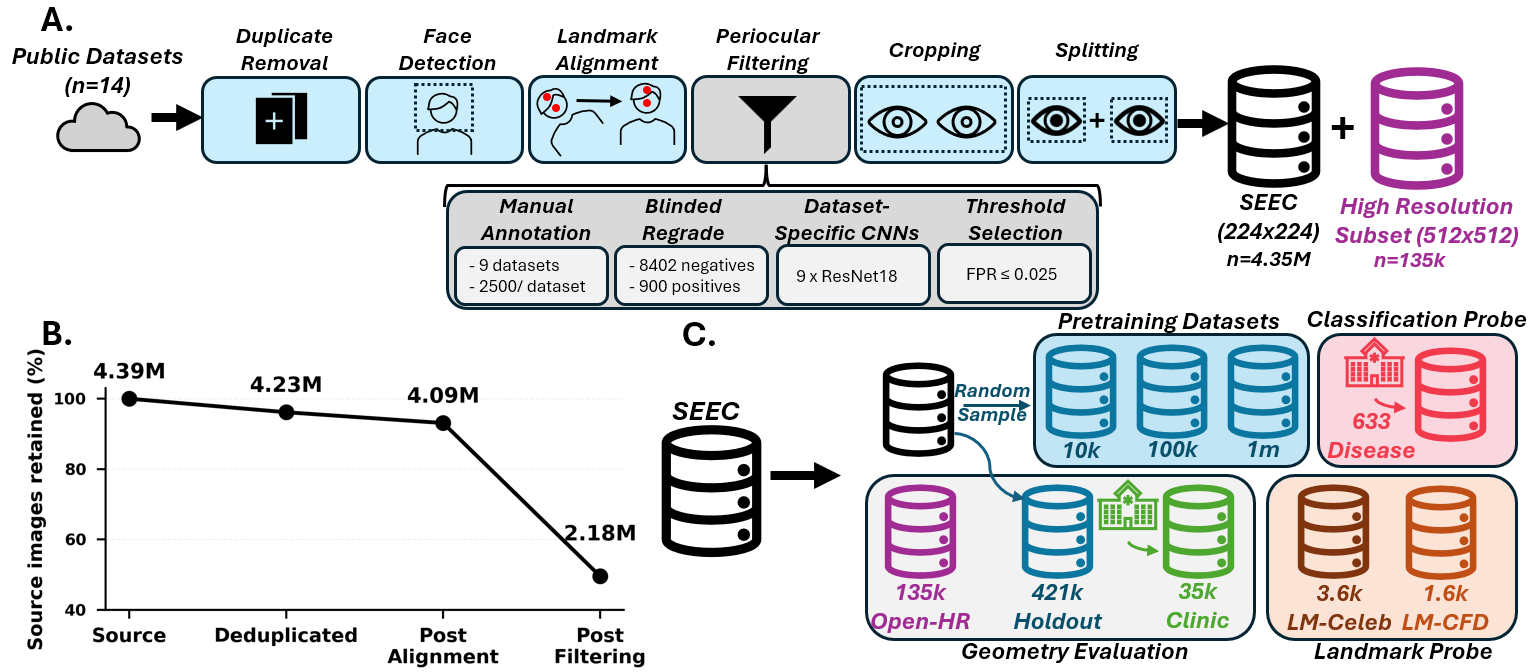
SEEC was developed to support large-scale, general-purpose representation learning from external-eye images. The corpus contains 4,352,692 standardized unilateral 224×224 periocular crops derived from 14 public source datasets, together with a 134,969-image high-resolution subset at 512×512. The accompanying benchmark evaluates learned representations across embedding geometry, anatomical landmark recovery, cross-dataset anatomical transfer, and disease classification, providing a common framework for studying whether external-eye representations capture reusable anatomical and clinically relevant information.
Resources
| Dataset | Images |
|---|---|
| SEEC | 4,352,692 |
| Pretrain-10K | 10,000 |
| Pretrain-100K | 100,000 |
| Pretrain-1M | 1,000,000 |
| Holdout | 421,730 |
| Open-HR | 134,969 |
| Clinic | 35,082 (restricted) |
| LM-Celeb | 3,610 |
| LM-CFD | 1,596 |
| Disease | 633 (restricted) |
Benchmark
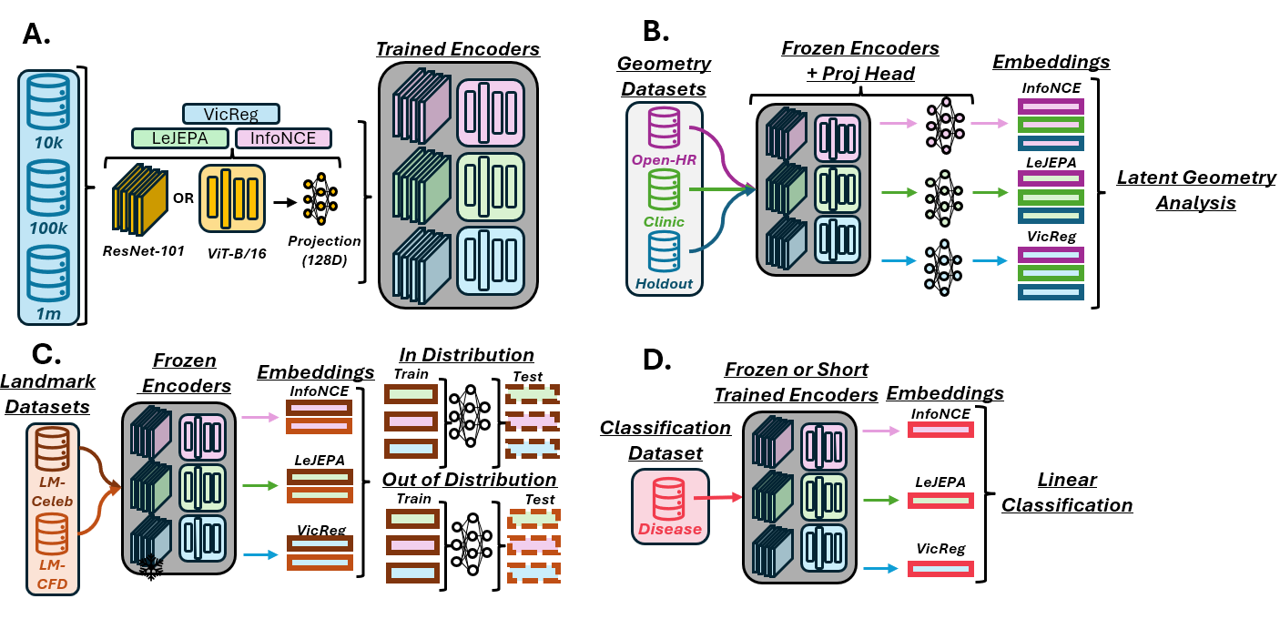
The benchmark evaluates four tasks: embedding geometry, anatomical landmark recovery, cross-dataset anatomical transfer, and disease classification.
Dataset reconstruction
SEEC is reconstructed from original source datasets using released manifests. Source-specific terms still apply. Clinical resources are restricted and are not publicly released.
Dataset reconstruction toolkit →
Current reconstruction manifest archive →
Documentation
Intended Use
SEEC is intended for external-eye/periocular representation-learning research and benchmarking. It is not intended for face recognition or identity verification.
Authors
George R. Nahass
Michelle Fleishaker
Sanjay Ganesh
Sasha Hubschman
R. V. Paul Chan
Pete Setabutr
Ann Q. Tran
Sathya Ravi
Department of Ophthalmology and Visual Sciences, University of Illinois Chicago
Department of Computer Science, University of Illinois Chicago
Artificial Intelligence in Ophthalmology, University of Illinois Chicago
Citation
Final manuscript citation forthcoming.